

Key Takeaways
A sound cooling system depends on more than the radiator alone. Correct fitment, careful diagnosis, and a methodical replacement process help prevent repeat leaks and overheating.
- Identify the radiator’s core, tanks, tubes, fins, hoses, cap, and expansion tank before ordering parts.
- Match replacement components by model, year, engine, transmission, VIN, and original part number.
- Compare new, aftermarket, and used parts by condition, warranty, fitment, and total cost.
- Treat overheating as a cooling-system diagnosis, not automatic proof that the radiator is faulty.
- Refill, bleed, and test the system carefully after installation.
Understanding Ssangyong radiator parts and their roles
The radiator is one part of a connected cooling system. Coolant moves through the engine, carries heat away, and then passes through the radiator before returning to the engine. Understanding how the components work together makes it easier to choose ssangyong radiator parts without relying on appearance alone.
A replacement radiator can look nearly identical to the original while having different hose outlets, mounting points, or transmission-cooling connections. That is why the surrounding components deserve attention too. A small mismatch can turn a straightforward repair into a frustrating installation.
How the radiator keeps the engine at operating temperature
Combustion creates heat that must be controlled within a suitable operating range. Coolant absorbs heat inside the engine and is directed to the radiator, where airflow removes much of that heat before the coolant circulates again. The thermostat helps regulate when this flow reaches the radiator, while the fan supports airflow when vehicle speed is low.
The radiator does not make the engine cold; it helps release excess heat so the engine can remain within its intended temperature range. A healthy system therefore supports steady temperature behavior rather than dramatic swings between hot and cold.
Core, tanks, tubes, and fins explained
The core is the central heat-transfer section. It contains narrow tubes through which coolant travels, with fins around them to increase the surface area exposed to air. The tanks collect and distribute coolant at either side or along the top and bottom, depending on the radiator design.
Damage to any of these areas can affect performance. Bent fins may restrict airflow, while a cracked tank or leaking tube can reduce coolant volume. Light surface dirt is usually less concerning than compacted debris that blocks a large portion of the fin area.
The purpose of radiator hoses and clamps
Radiator hoses connect the radiator to the engine and other parts of the cooling circuit. They must tolerate heat, pressure, and repeated movement without becoming soft, brittle, swollen, or cracked. Clamps maintain the seal at each connection, so a hose that appears sound can still leak if its clamp has weakened or shifted.
When replacing a radiator, inspect the hose necks and the hose ends at the same time. A new radiator paired with an old hose can leave the original failure point untouched. Use the correct clamp style and position it behind the bead on the radiator outlet rather than at the very edge.
How the radiator cap and expansion tank support coolant pressure
The radiator cap controls pressure in the sealed cooling system and allows coolant to move to and from the expansion tank as temperature changes. The expansion tank provides room for coolant to expand when hot and return as the system cools. A damaged seal, incorrect pressure rating, or cracked tank can disturb this cycle.
Never judge a cap by appearance alone. Its pressure rating and fit must match the vehicle’s requirements. If coolant is disappearing without an obvious puddle, the cap, tank, hoses, water pump, and internal engine condition all deserve consideration.
Diagnosing common radiator and cooling system problems
Cooling-system symptoms often overlap, which is why replacing the first suspicious part is not always the best approach. A damp mark may indicate a hose, clamp, tank, or radiator seam rather than a failed core. Likewise, overheating can result from restricted airflow, trapped air, a thermostat, or a water pump.
Begin with the engine completely cold and look for evidence before opening the system. Record when the symptom appears, whether the heater works, and whether the temperature changes in traffic or at highway speed. A careful pattern is more useful than a single warning light.
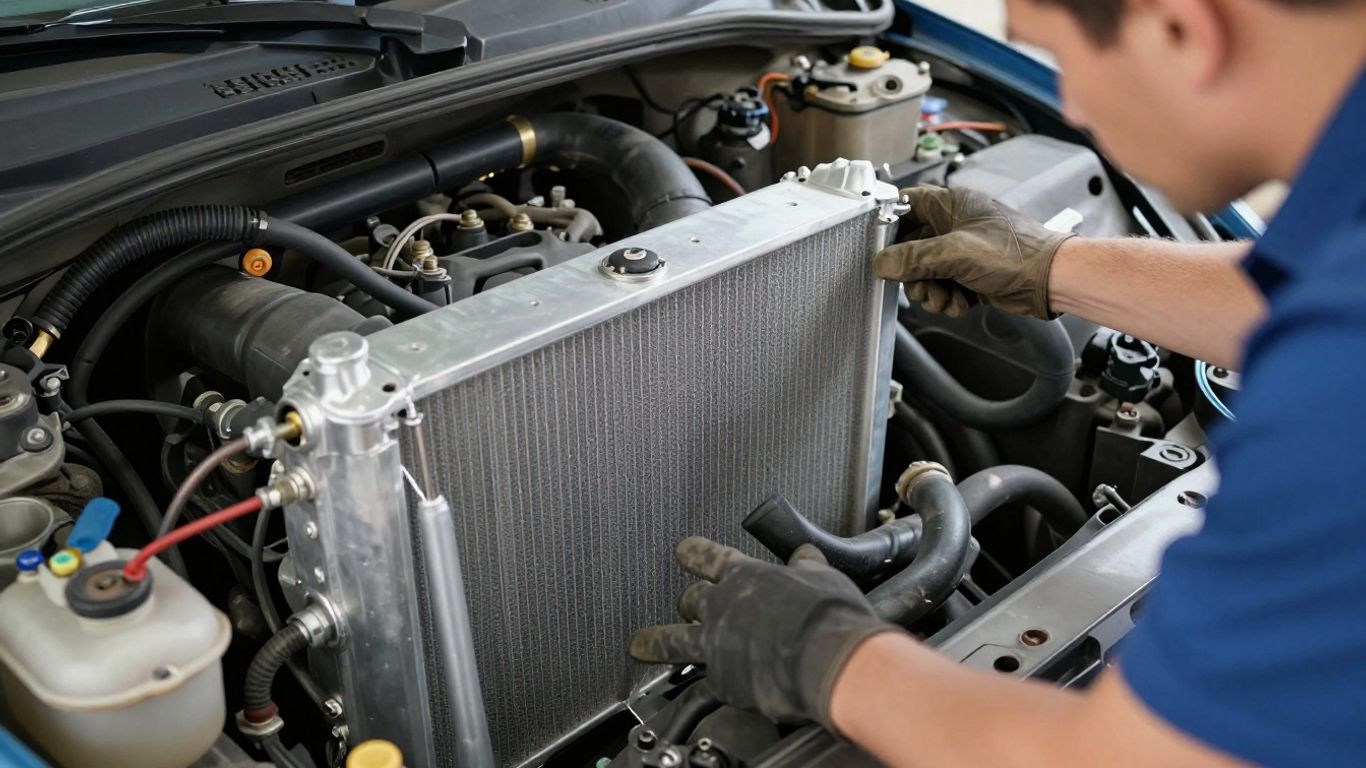
A visual inspection should include the radiator, connections, fan area, and the ground beneath the vehicle. Specialist technicians may also perform a cooling-system pressure check; radiator replacement and repair services can be a useful reference when deciding whether professional diagnosis is appropriate.
Warning signs of a leaking radiator
Common clues include a sweet coolant smell, a low reservoir, visible wetness, dried colored residue, or steam from the front of the vehicle. A leak may only appear once the system is hot and pressurized, so a dry inspection after parking does not always rule it out.
Do not remove a radiator cap from a hot engine. If the temperature warning appears or steam is escaping, stop safely, switch off the engine, and allow it to cool. Continuing to drive with low coolant can cause damage well beyond the original leak.
How overheating, coolant loss, and temperature changes are connected
Coolant loss reduces the system’s ability to carry heat away. As the level falls, air can enter the circuit, which may create irregular temperature readings and reduce heater performance. A temperature spike in slow traffic can point toward airflow or fan concerns, while overheating under load may suggest a broader circulation or capacity problem.
The sequence matters. Note whether the reservoir level falls after each drive, whether the gauge rises suddenly or gradually, and whether the upper hose becomes unusually hard. These observations help a technician distinguish a radiator leak from another cooling-system fault.
Checking for blocked fins, damaged hoses, and weak caps
Inspect the radiator face for leaves, mud, insects, and bent fins. Check hoses for cracking, swelling, soft spots, or abrasion, and look around clamps for dried coolant traces. A pressure test of the cap and system can reveal leaks that are not visible during a basic inspection.
A useful inspection routine keeps the possibilities organized:
- Check coolant level only when the engine is cold.
- Look for residue around tanks, seams, hose necks, and clamps.
- Inspect the radiator face from both the front and the engine side.
- Compare the cap’s pressure rating with the vehicle specification.
These checks do not replace a proper diagnosis, but they can prevent an unnecessary parts order. They also give you clearer information when discussing the repair with a supplier or workshop.
When a radiator issue may actually involve the water pump or thermostat
A thermostat that remains closed can restrict coolant flow and cause rapid overheating, while one that remains open may leave the engine running too cool. A worn water pump may circulate coolant poorly, sometimes accompanied by noise, leakage, or a change in behavior as engine speed rises.
The radiator should be considered alongside these components. If there is no external radiator leak but the engine still overheats, testing circulation, thermostat operation, fan performance, and combustion-gas intrusion may be more productive than fitting another radiator.
A general video on radiator diagnosis and replacement can help you understand the sequence of checks, but it should not substitute for model-specific service information or a qualified assessment.
Choosing compatible parts for your SsangYong model
Fitment is the central issue when buying replacement cooling components. SsangYong vehicles can differ by model generation, engine, transmission, production period, and market specification. Even when two radiators share similar dimensions, their outlets, mounts, and internal arrangements may not match.
Use the vehicle identification details before comparing prices. A listing that says it fits a broad range of vehicles may still require confirmation of the exact engine and transmission combination. Exact fitment matters most when the part is difficult to return or shipping is expensive.
Matching parts by model, year, engine, and transmission
Start with the full model name, model year, engine size, fuel type, and transmission. Some radiators include an integrated cooler for automatic transmission fluid, while others are designed only for engine coolant. Body style and drive configuration can also affect mounting points and surrounding clearance.
Write these details down before searching. If a supplier asks for a registration or chassis detail, provide it rather than guessing from a photograph. The more precise the initial information, the less likely it is that a visually similar part will be ordered by mistake.
Comparing petrol and diesel cooling system requirements
Petrol and diesel engines can use different radiator specifications, hose layouts, fan arrangements, and cooling capacities. Turbocharged engines or vehicles used for towing may place additional demands on the cooling system, although the correct requirement remains specific to the vehicle’s factory configuration.
Do not assume that a radiator for one fuel type will work for another simply because the external dimensions match. Compare connection sizes, mounting positions, core dimensions, and any transmission or auxiliary-cooling provisions listed for the exact application.
Using the VIN and original part number to confirm fitment
The VIN can help a supplier identify the precise vehicle specification. The original radiator’s part number is also valuable, especially when a vehicle has several revisions or when catalog descriptions are incomplete. Photograph the label, mounting points, and connections before removal if the old part is still accessible.
You can also keep a written record of the old component’s dimensions and outlet orientation. This is especially useful when comparing listings such as radiators for sale, where new and pre-owned options may be grouped together under broad model terms.
Avoiding problems with similar-looking but incompatible components
A photograph cannot confirm internal construction, pressure requirements, or the presence of an integrated cooler. Check whether the inlet and outlet are on the same sides as the original, whether the mounting pegs align, and whether the fan shroud and drain plug positions are compatible.
Ask for clarification when a listing omits a measurement. It is better to delay an order than to force a hose onto the wrong neck or discover that the fan assembly cannot be mounted. Keep the original part until the replacement has been compared and accepted.
Comparing new, aftermarket, and used radiator parts
The best choice depends on the vehicle’s condition, repair budget, availability, and the confidence you have in the supplier. A new original-equipment part may offer the closest match, while an aftermarket component can be practical when its specification is well documented. A used radiator may suit an older vehicle, but its history and condition need careful review.
Price alone is a poor comparison. Include seals, hoses, coolant, delivery, labor, and the cost of returning an incorrect part. For older vehicles, a used radiator can be reasonable when it has been inspected and the savings justify the remaining uncertainty.
Listings for pre-owned radiators can help establish what is available, but availability is not proof of condition. Look for clear photos, application details, and a stated return policy before treating any used component as a serious option.
When an OEM radiator is worth the investment
An OEM radiator can be attractive when exact fit, original connections, and long-term ownership matter more than the lowest purchase price. It may also be sensible when the vehicle is newer, difficult to work on, or being restored to its original specification.
Even then, verify the part number and vehicle application. “OEM” should not remove the need to confirm fitment, and a reputable seller should be able to explain what is included and how the part is covered if it fails.
Benefits and limitations of aftermarket replacements
Aftermarket radiators can offer broader availability and a lower initial price. Some are built to match the original dimensions and connections, but quality and catalog accuracy vary between suppliers and applications. Read the specification rather than relying on a generic compatibility statement.
Check the core dimensions, tank material, outlet arrangement, drain location, and any cooler provisions. A lower price becomes less appealing if the radiator requires altered hoses, additional fittings, or repeated removal because of a poor fit.
What to inspect when buying a used radiator
Ask whether the radiator was pressure-tested, flushed, or removed from a running vehicle. Examine the tanks for cracks, the fins for severe damage, and the hose necks for distortion. Corrosion around seams and mounting points deserves particular caution.
A used radiator should arrive with its identity and application clear. Resources for used radiators and condensers show why location, seller details, and delivery arrangements can matter as much as the listed component itself.
Evaluating warranty coverage, condition, and supplier reputation
Warranty language should explain the coverage period, exclusions, proof of purchase, and whether labor or shipping is included. A warranty is useful only if the supplier can be contacted and the return process is practical. Keep photographs of the packaging and part condition when it arrives.
Supplier reputation is also about accuracy. A seller that answers fitment questions directly and provides measurements is generally easier to deal with than one offering only stock images. The same habit applies to broader marketplace decisions; a general consumer rights guide can help you understand questions to ask about returns and faulty goods.
Buying Ssangyong radiator parts with confidence
A good order begins with a complete description of the vehicle and ends with a written confirmation of what will arrive. Avoid treating a low listed price as the full cost until delivery, taxes, fittings, coolant, and installation have been considered. Clear communication saves more time than rushing to checkout.
It is also worth separating diagnosis from purchasing. If the radiator has not been tested, ask whether a repair, hose, cap, thermostat, or fan issue could be responsible. This keeps the repair focused on the actual fault rather than the most visible component.
Questions to ask before placing an order
Ask the supplier to confirm the exact model, year range, engine, fuel type, transmission, and part number. Clarify whether the radiator is new, refurbished, or used, and whether it has been pressure-tested. If the listing is vague, request photographs of the connections and mounting points.
For online research, unrelated-looking buying guides can still reinforce the value of checking assumptions: an options trading guide, for example, illustrates why terms, risk, and contract details should be understood before committing money. The radiator order itself, however, should remain grounded in vehicle-specific evidence.
Checking dimensions, connections, and included hardware
Compare the replacement with the original before installation. Measure the core height and width, note the overall thickness, and check the inlet and outlet diameters. Confirm whether brackets, drain plugs, seals, caps, and transmission-cooler fittings are included or must be purchased separately.
A simple written comparison can prevent an expensive surprise. Pay particular attention to hose orientation and fan-shroud clearance, because those details are easy to miss in a front-facing product image.
Understanding shipping, returns, and warranty terms
Radiators are vulnerable to shipping damage, especially around thin fins, plastic tanks, and mounting tabs. Inspect the package before signing where possible, and photograph visible damage. Read the return window and find out whether the part must be unused for a return to be accepted.
Confirm who pays return shipping for an incorrect fitment and what evidence is required for a warranty claim. If delivery timing matters, ask whether the listed stock is physically available or supplied after ordering.
Estimating the total replacement cost
The purchase price is only one part of the repair. Labor, coolant, replacement clamps, hoses, a cap, disposal, delivery, and possible diagnostic testing can change the final amount. If the cooling system has been contaminated or badly corroded, flushing may add time and materials.
A practical estimate should include a small allowance for related wear items. For example, replacing an aged hose while the radiator is already removed may be more efficient than paying for the same access work later.
Replacing and maintaining radiator components
Radiator replacement is manageable for an experienced home mechanic, but coolant is hot, pressurized, and harmful if mishandled. Work on a level surface with the engine fully cool, protect painted surfaces, and follow the vehicle’s service information. If access is cramped or the system repeatedly overheats, professional help is the safer choice.
The replacement itself is only half the job. The system must be drained without unnecessary spills, refilled with suitable coolant, and checked for trapped air and leaks. A careful final test is what turns a new component into a reliable repair.
Preparation and safety steps before removing parts
Gather the replacement radiator, correct coolant, drain pan, tools, new clamps or hoses if needed, gloves, and eye protection. Disconnect the battery if the repair procedure requires work near electrical fans, and keep hands clear of fans that may start automatically. Never loosen a hot radiator cap.
Before draining, photograph hose routing and connector locations. Labeling electrical plugs and placing fasteners in separate containers can make reassembly less error-prone, particularly when the fan shroud or condenser must be moved for access.
Flushing the cooling system and installing a replacement radiator
Drain the old coolant into a suitable container and dispose of it according to local requirements. Flush only as directed for the vehicle and coolant type; aggressive or incompatible chemicals can damage seals and metals. Remove debris from the radiator mounting area before positioning the replacement.
Transfer only the components that are confirmed to be reusable. Seat hoses fully, position clamps correctly, and make sure the radiator is supported without strain on the tanks or hose necks. Refit the fan shroud and any transmission-cooler lines carefully, checking for leaks at every connection.
Bleeding trapped air and checking coolant levels
Refill with the specified coolant mixture and follow the vehicle’s bleeding procedure. Some systems use a bleed screw, while others require a particular heater setting, engine speed, or warm-up cycle. Air pockets can cause poor heater output, unstable temperatures, and false confidence after a first refill.
After the engine cools, recheck the reservoir and top up if necessary. Inspect the radiator, hoses, cap, drain point, and ground beneath the vehicle. Repeat the checks over several drives rather than assuming that one stationary test proves the repair is complete.
Preventing future corrosion, leaks, and overheating
Use the correct coolant and observe its replacement interval. Do not mix products unless the manufacturer’s instructions allow it, and do not use plain water as a long-term substitute. Keep the radiator face clear and investigate even small coolant losses before they become major leaks.
A useful maintenance record includes the coolant type, service date, replaced parts, and any temperature symptoms. For general household energy-maintenance ideas, a fan energy guide discusses cleaning, positioning, and efficient use; those principles are separate from vehicle cooling but still underscore the value of keeping airflow paths clear.
Conclusion
Choosing the right SsangYong radiator component starts with diagnosis and ends with verified fitment, safe installation, and careful testing. Compare the complete specification rather than a photograph or headline price, and treat hoses, caps, airflow, thermostats, and water pumps as part of the same cooling-system conversation.
Frequently Asked Questions
How long does a radiator usually last?
Service life varies with coolant condition, corrosion, climate, road debris, maintenance, and vehicle use. A radiator should be assessed by condition and symptoms rather than replaced solely because it has reached a particular age.
Can a leaking radiator be repaired?
Some leaks can be repaired, but the practical choice depends on the leak location, material, corrosion, accessibility, and repair quality. A professional inspection can determine whether repair or replacement is more dependable.
Can I drive with a small coolant leak?
Driving with a coolant leak is risky because a minor seep can become a rapid loss of coolant. If the temperature rises, a warning appears, or steam is visible, stop safely and allow the engine to cool before arranging assistance.
Should the radiator cap be replaced with the radiator?
Not automatically, but the cap should be inspected and tested. If its seal is damaged or its pressure rating is incorrect, replacing it may be necessary to restore proper system operation.
What coolant should I use after replacing a radiator?
Use the coolant type and mixture specified for the vehicle. Compatibility matters, and mixing different coolant technologies without guidance can reduce protection or create contamination.
Why does the temperature rise in traffic but not on the highway?
That pattern may indicate inadequate airflow at low speed, such as a fan or shroud issue, though coolant level, radiator restriction, and other components should also be checked. The symptom alone cannot identify one failed part.
Is a used radiator a safe choice?
A used radiator can be suitable when its application is confirmed and its tanks, fins, seams, connections, and pressure performance have been checked. A clear return policy provides useful protection if a hidden defect appears.
For additional tasting-related reading unrelated to vehicle repair, see this wine tasting guide; the same broader habit of comparing details carefully is useful when evaluating any purchase.