

Key Takeaways
Choosing the right clutch components starts with accurate vehicle identification and ends with careful installation. The symptoms, the condition of related parts, and the supplier’s documentation all matter.
- Confirm the model, engine, transmission, production year, and VIN before ordering.
- Treat the disc, pressure plate, release bearing, and hydraulic system as one working system.
- Diagnose slipping, dragging, noise, and vibration before deciding which parts to replace.
- Compare a complete kit with individual parts after inspecting the flywheel and related seals.
- Follow alignment, torque, break-in, and post-installation checks to avoid premature wear.
Understanding the Ssangyong clutch system
A clutch sits between the engine and manual transmission, allowing the driver to interrupt power temporarily while starting, stopping, or changing gears. Although the mechanism looks straightforward, several components must work together under heat, pressure, and repeated movement. Understanding that relationship makes it easier to choose and diagnose Ssangyong clutch parts without guessing.
How the clutch transfers engine power
When the clutch pedal is released, the pressure plate clamps the friction disc against the flywheel. Engine torque then passes through the disc hub and into the transmission input shaft. Pressing the pedal moves the release mechanism, reducing clamping force so the engine and transmission can rotate at different speeds during a gear change.
A smooth engagement depends on controlled friction rather than a simple on-or-off connection. Excessive heat, contamination, or an uneven contact surface can interrupt that process. A vehicle that shudders or struggles to move away may therefore have a problem with more than the visible friction lining.
The role of the clutch disc and pressure plate
The clutch disc carries friction material around its outer circumference and uses springs in its hub to soften torsional shocks. The pressure plate provides the force that presses the disc against the flywheel. If either component is worn, glazed, distorted, or contaminated with oil, the clutch may fail to transmit torque consistently.
Disc wear is not measured only by remaining lining thickness. The condition of the hub splines, damper springs, rivets, and contact surfaces also matters. Likewise, a pressure plate can appear intact while its diaphragm spring has lost consistency or its face has developed hot spots.
Why the release bearing and slave cylinder matter
The release bearing transfers movement from the clutch fork or concentric hydraulic assembly to the pressure plate. It operates whenever the pedal is depressed, so roughness or noise may appear before the friction disc is obviously worn. A bearing that binds can also make pedal effort feel uneven.
The slave cylinder converts hydraulic pressure into mechanical movement. Leaks, air in the line, a damaged seal, or a sticking piston can prevent full disengagement. That creates symptoms similar to a worn clutch, which is why the hydraulic circuit should be checked before removing the transmission.
How the flywheel affects clutch performance
The flywheel provides the friction surface against which the disc works and helps stabilize engine rotation. Its face must be flat and suitable for the replacement clutch. Cracks, deep scoring, blue heat marks, or excessive movement in a dual-mass design can undermine a new clutch.
Resurfacing is not automatically appropriate. The machinist must preserve the correct surface geometry and step height for the pressure plate. If the flywheel cannot be returned to specification, replacement is usually the more reliable route.
Choosing compatible Ssangyong clutch parts
Fitment is more precise than matching a vehicle name to a catalog picture. The same model line may use different engines, transmissions, clutch diameters, release systems, or flywheels across production years and markets. Before comparing prices, collect the identifying information that separates one application from another.
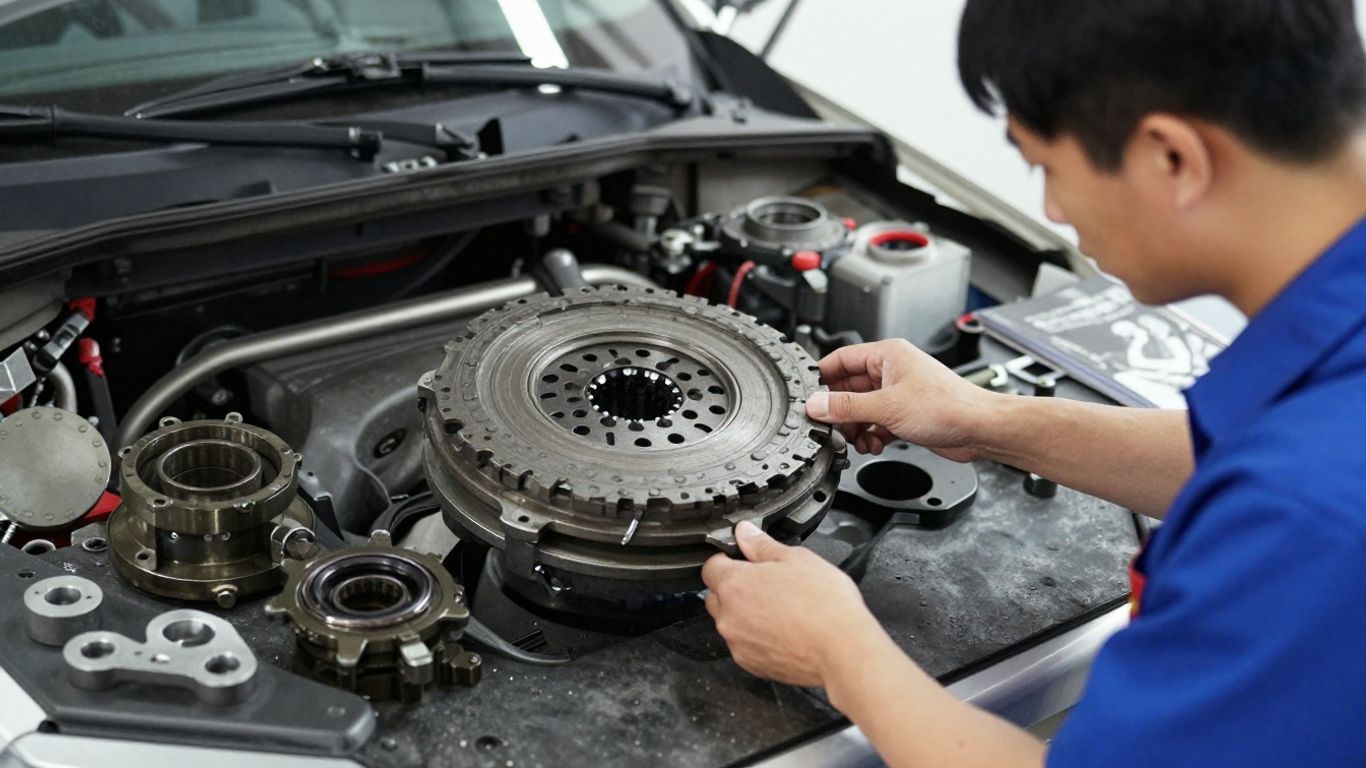
That preparation is especially useful when reviewing global sourcing strategy guidance: supplier selection and sample validation are only useful when the underlying specification is clear. The same principle applies to a local parts order—verify the application first, then assess the seller and the component.
Matching parts to the model and engine
Start with the exact model, engine code, drivetrain, and transmission designation. Do not rely on a broad description such as “diesel manual” if the catalog offers several variants. Clutch diameter, spline count, release mechanism, and flywheel design may differ even when the vehicles look nearly identical.
Record the current part numbers where possible. A mechanic can also compare the removed disc and pressure plate with the proposed replacements, but physical similarity alone is not proof of compatibility. The part must match the vehicle’s mechanical specification, not merely its appearance.
Checking transmission type and production year
The transmission type determines how the clutch disengages and how the disc connects to the input shaft. Production year can matter because manufacturers revise engines, gearboxes, hydraulic systems, and flywheel assemblies during a model’s run. Imported vehicles may add another layer of variation.
A useful catalog check should show the applicable build dates, engine codes, transmission codes, and any exclusions. If those details are missing, ask the supplier for confirmation rather than assuming that an apparently complete kit will fit.
Using the VIN to confirm fitment
The VIN is the strongest starting point for a parts lookup because it identifies the individual vehicle rather than only the model family. Give the full VIN to the supplier and ask for written confirmation of the matching part numbers. Keep that response with the order in case a return or exchange becomes necessary.
VIN verification still benefits from a visual check. The vehicle may have received a previous repair or replacement assembly, and regional catalog data can be incomplete. A discrepancy between the VIN result and the installed components deserves investigation before the transmission is removed.
Avoiding differences between original and aftermarket specifications
Original-equipment and aftermarket components can use different packaging, friction materials, damper tuning, or included hardware. That does not automatically make one option unsuitable, but the specification and application data must be transparent. Check whether the kit includes the release bearing, pilot bearing, alignment tool, bolts, or hydraulic component you actually need.
Price should be considered alongside warranty terms, traceability, and technical support. A lower-cost component that cannot be verified may create additional labor if it has to be removed and returned. Even a supplier directory such as the IMG Academy visit guide illustrates a broader planning lesson: access, timing, and preparation should be confirmed before the day of use.
Diagnosing common clutch problems
Clutch symptoms often overlap, so diagnosis should follow a sequence rather than a single test. Note when the symptom appears, whether the engine is hot or cold, and whether it changes with pedal position. A short road test, fluid inspection, and visual check can narrow the possibilities before parts are ordered.
Identifying clutch slipping under load
Slipping occurs when engine speed rises without a matching increase in road speed. It is easiest to notice during hard acceleration in a higher gear or while climbing, although a worn clutch can slip under lighter loads as wear progresses. A burning odor may follow repeated slipping, but its absence does not rule the problem out.
Possible causes include worn friction material, a contaminated disc, a weak pressure plate, an incorrect adjustment, or a hydraulic system that is not allowing full clamping. Testing should be controlled and brief; deliberately overheating the clutch can turn a developing fault into a damaged flywheel.
Recognizing clutch drag and difficult gear changes
Clutch drag means the disc continues to turn when the pedal is fully depressed. Reverse may grind, first gear may resist selection, or the vehicle may creep with the pedal down. The fault can come from air or leakage in the hydraulic circuit, insufficient travel, a warped disc, damaged splines, or a release mechanism that binds.
Check pedal travel and hydraulic movement before condemning the friction components. If the clutch disengages correctly at the slave cylinder but gears remain difficult to select, internal transmission or pilot-bearing issues may also need attention.
Investigating clutch pedal noise or vibration
A squeal, growl, click, or scraping sound can change as the pedal moves. Noise that appears only while pressing the pedal points toward the release bearing or release mechanism, while noise with the pedal released may come from the disc, flywheel, or transmission. Vibration during engagement can result from uneven surfaces, contamination, mounting problems, or engine and transmission movement.
Use the timing of the noise as evidence, not as a complete diagnosis. The Ssangyong clutch kits listings can help establish what a replacement package may contain, but the vehicle’s actual symptom and confirmed fitment still determine what should be purchased.
Distinguishing hydraulic faults from worn friction parts
Hydraulic faults often produce a soft, sinking, or inconsistent pedal, visible fluid loss, or a clutch that fails to disengage fully. Worn friction parts more commonly produce slipping, shuddering, or a high engagement point, although symptoms can overlap. Inspect the reservoir, lines, master cylinder, slave cylinder, and connections for leaks or air.
A simple symptom record helps organize the investigation. The table below is a guide for prioritizing checks, not a substitute for measuring travel or inspecting removed parts.
| Symptom | First checks | Possible area | Next step |
|---|---|---|---|
| Engine revs rise under load | Road test, odor, pedal position | Disc or pressure plate | Check contamination and wear |
| Reverse grinds with pedal down | Hydraulic travel, pedal action | Slave cylinder or disc | Bleed and measure movement |
| Growl while pressing pedal | Noise timing, bearing feel | Release bearing | Inspect release mechanism |
| Shudder on takeoff | Mounts, flywheel face, disc | Friction surfaces | Inspect for hot spots or distortion |
This comparison prevents a hydraulic complaint from automatically becoming a full clutch replacement. Conversely, if hydraulic movement is correct and the friction surfaces are damaged, replacing only a cylinder may leave the original fault unresolved.
Deciding between individual parts and a complete clutch kit
The correct scope of repair depends on inspection, access, mileage, and the condition of related components. Because removing a transmission is labor-intensive, replacing a marginal part while everything is accessible can be sensible. That decision should still be based on evidence, not on the assumption that every vehicle needs every available component.
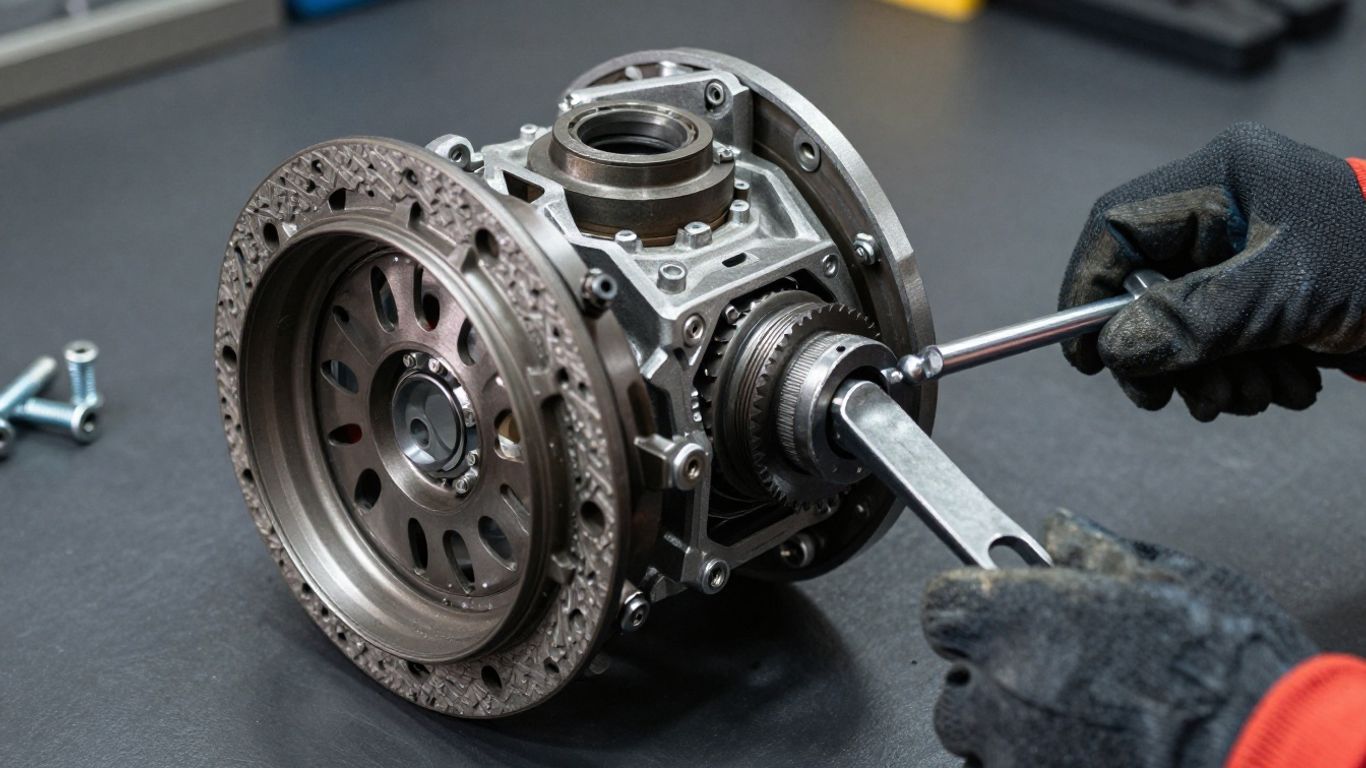
A complete kit may simplify ordering, but the contents vary by application. For example, a listing for Clutch Industries describes a kit that includes a clutch disc, pressure plate, dual-mass flywheel, and concentric slave cylinder; those inclusions should never be assumed for a different vehicle or part number.
When replacing the clutch disc alone may be suitable
Replacing the disc alone can be reasonable when the pressure plate is within specification, the release bearing is quiet and smooth, the flywheel is sound, and the failure is clearly limited to the friction disc. This approach may also suit a recent repair in which the other components have low service time and no signs of heat damage.
The difficulty is that the disc is rarely the only part exposed to wear. If the pressure plate face is scored or the release bearing feels rough, saving one component may simply postpone another transmission removal. A proper inspection should support the narrower repair.
Why pressure plates and release bearings are often replaced together
The disc and pressure plate wear against each other, while the release bearing operates as part of the same engagement cycle. Installing a new disc against a tired pressure plate can produce uneven clamping or inconsistent engagement. Reusing a noisy bearing is also a poor trade when access is already available.
Replacing these components together gives the new disc a known mating surface and restores the operating parts as a set. It does not remove the need to inspect the flywheel, hydraulic system, pilot bearing, or transmission input-shaft seal.
When a kit with a dual-mass flywheel makes sense
A dual-mass flywheel may be considered when the existing unit has excessive rotational play, damaged springs, noise, grease leakage, cracks, or a surface that cannot be restored. Its condition is particularly relevant when vibration or rattle preceded the clutch failure. The replacement must match the engine and transmission application exactly.
Do not select a dual-mass kit solely because it is more complete. Confirm that the vehicle was designed for that flywheel type, check the included release system, and compare the supplier’s part number with the VIN lookup. Installation instructions may also specify one-time-use bolts or tightening stages.
Evaluating related seals, bolts, and hydraulic components
Inspect the rear main seal area, transmission input-shaft seal, pilot bearing, clutch fork, pivot, guide tube, and hydraulic connections. Any oil leak should be repaired before new friction material is installed. Stretch bolts and other single-use fasteners should be replaced where the service procedure requires it.
A compact ordering check can reduce the chance of discovering a missing item after the vehicle is apart:
- Confirm the disc diameter, spline count, and pressure-plate specification.
- Confirm whether the release bearing or concentric slave cylinder is included.
- Check the flywheel type, condition, and required fasteners.
- Review seals, hydraulic parts, alignment tools, and warranty terms.
Once these points are confirmed, the choice between an individual component and a complete kit becomes a practical risk decision. The goal is not the largest box; it is a repair that addresses the observed failure without leaving a known weak link behind.
Assessing Ssangyong clutch parts for quality and value
Quality is difficult to judge from a product photograph or a discount alone. Look for clear application data, consistent part numbering, technical specifications, manufacturing traceability, and a warranty that explains what is covered. The best value is usually the option whose fitment and support are easiest to verify.
Comparing original equipment and aftermarket brands
Original-equipment parts are designed around the vehicle’s specified system, while reputable aftermarket parts may offer a compatible alternative with their own materials and testing. Compare the actual application, included components, and warranty rather than treating the label as a guarantee of service life.
For example, Sachs appears in the linked clutch-kit listings, and Valeo is also listed as a clutch-kit brand. Those listings establish availability of kits, not a universal claim that either brand is right for every vehicle. The application number remains the deciding detail.
Reviewing materials, tolerances, and warranty coverage
Ask what documentation is available for friction material, pressure-plate construction, flywheel limits, and release-bearing design. Tolerances matter because a component can be close in size yet incorrect in operating height or engagement geometry. Warranty coverage should state the duration, exclusions, installation requirements, and process for handling a defective part.
A warranty is more useful when the supplier can identify the exact item sold and provide installation guidance. Keep the invoice, VIN confirmation, packaging, and photographs of any unusual damage until the repair has been tested.
Balancing upfront price with expected service life
The purchase price is only one part of clutch cost. Labor, shipping, downtime, replacement fluids, machining, and the risk of repeating the job can outweigh a modest saving on the component itself. At the same time, an expensive kit is not automatically better if its contents and fitment are unclear.
Estimate the total repair before choosing. A documented kit with the necessary components may be economical, while a carefully inspected individual replacement may be appropriate for a vehicle with recently renewed supporting parts.
Checking supplier reputation and return policies
Read the return conditions before opening or installing the part. Many suppliers distinguish between unused items, special orders, electrical or hydraulic components, and parts that show installation marks. Confirm who pays return shipping and how an incorrect catalog match is handled.
Service quality also includes communication. A supplier that asks for the VIN, transmission code, and photographs of the old component is taking fitment seriously. For broader procurement decisions, even a serralheria guide that discusses experience, reputation, materials, equipment, and detailed quotations offers a useful general reminder: compare the process, not just the headline price.
Replacing and maintaining Ssangyong clutch parts
Clutch replacement requires safe lifting, stable support, correct tools, and enough time to inspect what is removed. The procedure varies by vehicle, so the workshop manual should control the sequence and torque values. Clean working practices matter because even a small amount of grease on the friction surfaces can cause renewed slipping.
Preparing the vehicle for clutch replacement
Disconnect the battery as required, raise and support the vehicle securely, and document cable, hose, bracket, and connector locations before disassembly. Drain or protect fluids according to the service procedure. Support the engine and transmission with suitable equipment rather than allowing mounts or shafts to carry unintended loads.
Before ordering last-minute parts, compare the replacement kit with the removed assembly. This is also the point to verify that the clutch fork, hydraulic line, starter area, mounts, and driveshaft components are accessible and serviceable.
Inspecting the flywheel and transmission during installation
Clean the bellhousing and inspect it for dust patterns, oil residue, broken fasteners, and damaged dowels. Check the flywheel for cracks, hot spots, scoring, and movement, then measure or assess it according to the manufacturer’s procedure. Inspect the input shaft splines and seal without flooding the new disc with lubricant.
The release fork, guide tube, pivot, and bearing contact points should move smoothly. If the transmission has to be forced into position, stop and find the cause; forcing it can damage the disc hub or input shaft.
Following correct alignment and torque procedures
Use the correct alignment tool so the disc sits concentrically with the pilot bearing or crankshaft. Tighten the pressure plate gradually in the specified sequence, and use a calibrated torque wrench for the flywheel, pressure plate, and transmission fasteners. Replace one-time-use bolts when the procedure calls for them.
Avoid applying grease to surfaces that are meant to remain dry. A small, correct amount on specified splines or guide surfaces is different from excess lubricant that can migrate onto the friction lining. The service manual’s torque values and tightening angles take priority over generic estimates.
Testing clutch operation and preventing premature wear
After reassembly, confirm pedal height, hydraulic fluid level, leak-free connections, gear selection, and engagement point. Start with a stationary check, then make a cautious road test for slipping, dragging, unusual noise, and vibration. Recheck the system if the pedal feels abnormal or the vehicle creeps with the clutch fully depressed.
Give a new clutch a sensible break-in period with smooth engagement and limited heavy loads, following the supplier or vehicle instructions. Avoid resting a foot on the pedal, holding the vehicle on an incline with clutch slip, and repeated high-load launches. Those habits create heat and can shorten the life of otherwise suitable parts.
Conclusion
The right clutch repair begins with accurate identification, continues with symptom-based diagnosis, and ends with careful inspection and installation. Whether the job calls for one component or a complete kit, matching the specification and checking the surrounding system will usually matter more than choosing by price alone.
Frequently Asked Questions
What are the main components of a manual clutch?
The main components are typically the clutch disc, pressure plate, release bearing, flywheel, and a mechanical or hydraulic release mechanism. Some systems also use a concentric slave cylinder or other integrated hydraulic assembly.
How can I tell if a clutch is slipping?
During acceleration, engine speed may rise without a proportional increase in vehicle speed. Slipping can be more noticeable in a higher gear, on a hill, or under heavy load, and may produce a hot friction odor.
Why is it difficult to select first or reverse gear?
The clutch may be dragging because of air or leakage in the hydraulic system, insufficient release travel, a warped disc, damaged splines, or a problem with the pilot bearing. Transmission issues can produce similar symptoms.
Should the flywheel always be replaced with the clutch?
No. The flywheel should be inspected and measured. It may be reusable or suitable for correct resurfacing, but cracks, severe heat damage, excessive movement, or an unrecoverable surface can justify replacement.
Is it better to buy a complete clutch kit?
A complete kit is often practical when the disc, pressure plate, and release bearing have similar service histories or when access makes future replacement expensive. Individual parts can make sense when the remaining components are recently replaced and demonstrably sound.
What information is needed to confirm clutch fitment?
Provide the vehicle model, engine code, transmission type, production year, market or region, and full VIN. Existing part numbers and photographs can help resolve differences between catalog data and the installed assembly.
How can a new clutch be protected from early wear?
Keep oil and grease away from friction surfaces, follow alignment and torque procedures, bleed the hydraulics correctly, and complete a careful road test. During break-in, avoid prolonged slipping, aggressive launches, and resting a foot on the clutch pedal.